
PaychainX and the Future of AI-Native Financial Infrastructure


Why the Next Generation of Commerce Will Be Governed by Intelligent Financial Execution Systems
Artificial intelligence is beginning to transform financial infrastructure itself.
For decades, financial systems were designed around:
human operators
manual workflows
static routing logic
delayed treasury coordination
isolated banking systems
fragmented settlement infrastructure
But modern commerce is becoming increasingly autonomous.
AI systems are now capable of:
initiating transactions
coordinating treasury movement
optimizing liquidity
routing settlement
forecasting operational risk
automating financial workflows
This creates the need for:
AI-native financial infrastructure.
And the orchestration layer becomes the foundation beneath it.
The Shift Toward Autonomous Commerce
Commerce is moving beyond:
static checkout systems
isolated payment gateways
manual treasury operations
The future includes:
intelligent payment execution
machine-driven settlement coordination
AI-assisted treasury systems
programmable liquidity
autonomous financial workflows
This transition fundamentally changes what payment infrastructure must become.
Why Legacy Infrastructure Cannot Support AI-Native Finance
Traditional financial systems were not designed for:
autonomous execution
real-time orchestration
continuous liquidity coordination
machine-to-machine commerce
programmable treasury logic
Most legacy infrastructure still depends on:
overnight settlement
fragmented APIs
manual reconciliation
disconnected systems
AI-native commerce requires:
deterministic execution
intelligent orchestration
programmable infrastructure
real-time verification
automated governance systems
The Rise of Financial Orchestration Infrastructure
As finance becomes more autonomous, orchestration becomes critical.
The orchestration layer coordinates:
routing
settlement
liquidity movement
treasury logic
compliance workflows
execution verification
AI-assisted decision systems
This transforms payments from:
transaction forwarding
into:
intelligent financial execution.
What PaychainX Is Building
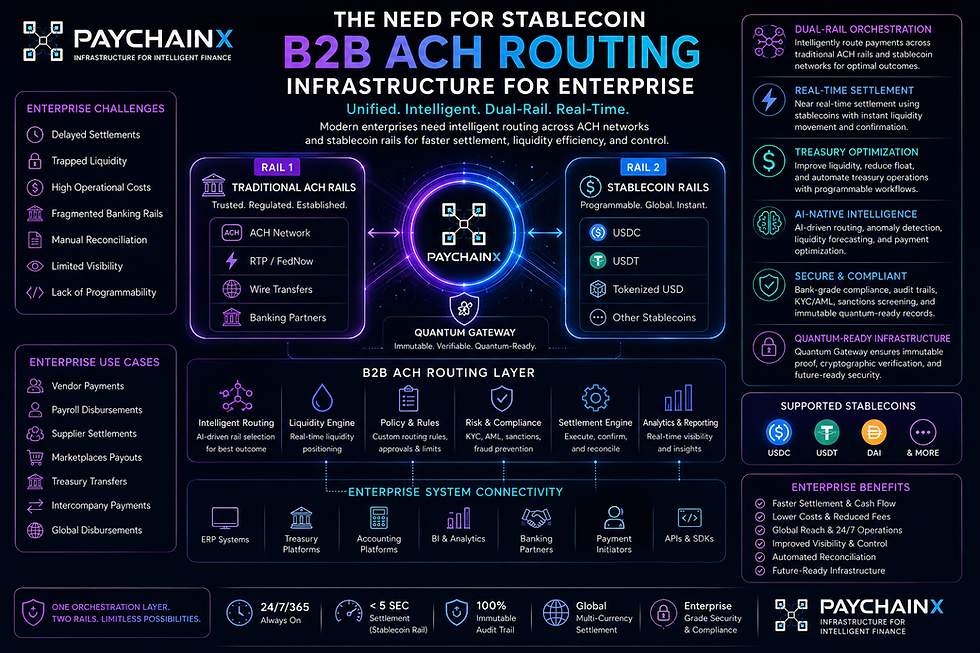
PaychainX is being architected as:
AI-native financial orchestration infrastructure
designed to coordinate:
traditional banking rails
stablecoin settlement systems
programmable treasury infrastructure
autonomous payment workflows
real-time liquidity movement
governed financial execution
through one unified infrastructure layer.
The Importance of Dual-Rail Infrastructure
The future financial stack will not rely on one settlement model.
Instead, commerce will increasingly operate across:
traditional financial rails
AND
digital settlement rails
simultaneously.
This creates:
dual-rail financial infrastructure.
Rail 1 — Traditional Financial Infrastructure
Traditional rails include:
Visa
Mastercard
ACH
RTP
FedNow
acquiring banks
sponsor banks
wire systems
These systems provide:
institutional trust
merchant adoption
regulatory structure
global financial connectivity
But they were not designed for:
autonomous commerce
programmable liquidity
AI-native orchestration
continuous execution systems
Rail 2 — Digital Settlement Infrastructure
Digital settlement rails introduce:
stablecoins
programmable settlement
tokenized liquidity
API-native finance
near real-time treasury movement
These systems enable:
continuous liquidity coordination
programmable financial execution
autonomous settlement systems
machine-native financial infrastructure
The future financial stack requires both systems working together.
AI and Treasury Infrastructure
Treasury systems are becoming increasingly intelligent.
AI systems can now assist with:
liquidity forecasting
routing optimization
treasury automation
payment timing
operational risk analysis
capital coordination
This transforms treasury infrastructure into:
intelligent financial operations systems.
Why Governance Matters
As AI systems participate more directly in commerce, governance becomes critical.
Autonomous systems require:
deterministic execution
policy enforcement
audit verification
cryptographic evidence
programmable controls
This is why infrastructure governance becomes a core requirement for AI-native finance.
The Quantum Gateway Model
The PaychainX Quantum Gateway introduces:
immutable transaction evidence
deterministic execution verification
cryptographic audit systems
quantum-ready infrastructure
governed financial execution
This creates a framework capable of supporting:
autonomous commerce
programmable finance
AI-native settlement systems
future financial infrastructure
The Future of Machine Commerce
Machine commerce is rapidly approaching reality.
Future systems may increasingly involve:
AI agents
autonomous treasury systems
programmable payment logic
intelligent settlement coordination
machine-to-machine financial execution
The infrastructure supporting these systems must be:
programmable
interoperable
deterministic
governed
real-time
secure
Why Infrastructure Leadership Matters
Historically, the companies that controlled infrastructure layers became foundational to entire industries.
Examples include:
operating systems
cloud platforms
networking infrastructure
database ecosystems
API platforms
In finance, orchestration infrastructure may become one of the most strategic layers of the next generation economy.
The Infrastructure Race Has Already Begun
Globally, companies are racing to modernize:
payment systems
treasury infrastructure
programmable finance
stablecoin interoperability
AI-native commerce
real-time settlement
The platforms that successfully coordinate these systems may ultimately define the future operating layer of global finance.
Conclusion
The future financial stack will increasingly become:
AI-native
programmable
real-time
interoperable
dual-rail
quantum-ready
The orchestration layer becomes the operational intelligence system beneath modern commerce.
PaychainX is building toward that future.
Not simply as a payment gateway.
But as infrastructure for:


Comments