
PaychainX and the Convergence of Banking Rails and Stablecoin Infrastructure


Why the Future Financial Stack Will Operate Across Both Traditional and Digital Settlement Systems
Global finance is entering a convergence era.
For years, traditional banking systems and digital asset infrastructure evolved separately.
Banking rails relied on:
ACH systems
wire transfers
card networks
acquiring banks
treasury institutions
settlement processors
Digital finance introduced:
stablecoins
tokenized liquidity
programmable settlement
blockchain-based coordination
API-native financial systems
Historically, these ecosystems operated independently.
That separation is now collapsing.
The future financial stack will increasingly operate across both environments simultaneously.
This creates the rise of:
dual-rail financial infrastructure.
And orchestration platforms are becoming the intelligence layer connecting everything together.
The Limits of Traditional Financial Infrastructure
Traditional payment systems remain foundational to global commerce.
They provide:
regulatory structure
institutional trust
merchant adoption
banking interoperability
global reach
But they also face structural limitations.
Most legacy systems still depend on:
banking windows
delayed settlement
fragmented APIs
regional infrastructure silos
manual treasury coordination
These systems were never designed for:
programmable liquidity
autonomous financial execution
AI-native commerce
continuous global settlement
The Rise of Stablecoin Infrastructure
Stablecoins are rapidly becoming operational financial infrastructure.
They enable:
programmable settlement
near real-time liquidity movement
API-native finance
tokenized treasury coordination
global financial interoperability
Unlike traditional settlement systems, stablecoins can operate continuously:
24/7
globally
programmatically
without banking-hour limitations
This fundamentally changes how value moves across the financial system.
Why Convergence Matters
The future of finance is not:traditional banking versus digital finance.
The future is:
orchestration between both systems.
Businesses increasingly require:
banking connectivity
stablecoin settlement
programmable treasury systems
real-time liquidity
intelligent routing
unified execution infrastructure
This creates demand for platforms capable of coordinating both rails simultaneously.
What PaychainX Is Building
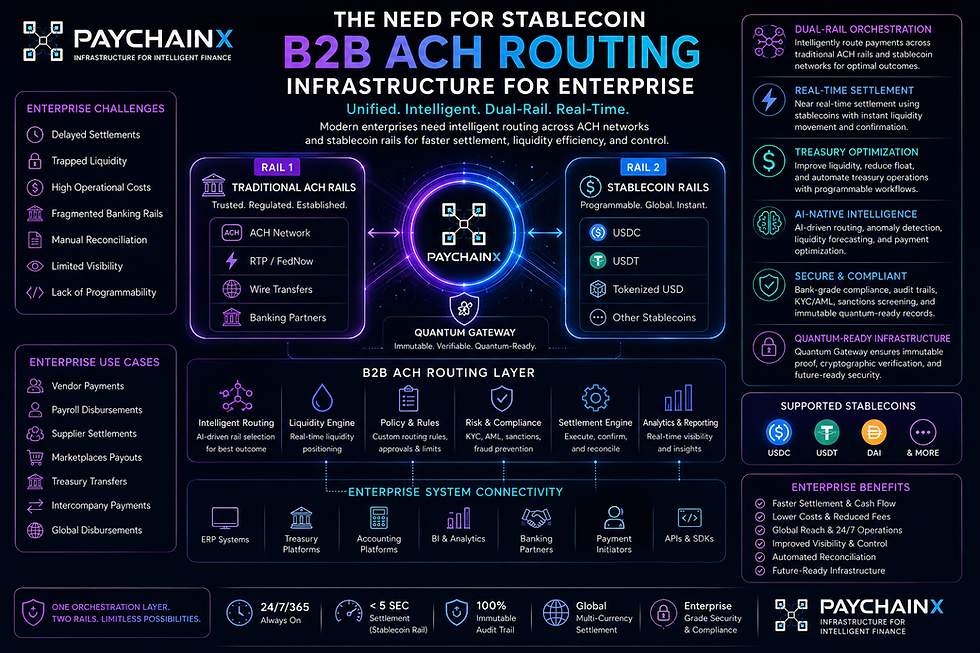
PaychainX is being architected as:
dual-rail financial orchestration infrastructure
designed to unify:
traditional banking rails
stablecoin settlement systems
programmable treasury infrastructure
real-time payment execution
AI-native orchestration
quantum-ready audit systems
through one intelligent execution layer.
Rail 1 — Traditional Banking Infrastructure
Traditional rails continue to power the majority of global commerce.
These include:
Visa
Mastercard
ACH
RTP
FedNow
sponsor banks
acquiring banks
wire systems
These rails remain critical because they provide:
trust
scale
merchant adoption
institutional compliance
financial regulation
But they increasingly require modernization.
Rail 2 — Digital Settlement Infrastructure
Digital settlement rails introduce:
stablecoins
programmable liquidity
tokenized financial coordination
API-native treasury movement
blockchain interoperability
These systems provide:
faster settlement
treasury flexibility
programmable finance
continuous liquidity coordination
machine-native execution systems
The next generation financial stack requires both systems operating together.
Why Orchestration Becomes the Strategic Layer
Processing payments is increasingly commoditized.
The strategic value shifts toward:
routing intelligence
treasury coordination
settlement orchestration
liquidity optimization
interoperability
execution governance
programmable finance
The orchestration layer becomes the control plane of modern financial infrastructure.
Treasury Infrastructure Is Also Changing
Treasury systems are evolving from:
passive reporting systems
to
active orchestration systems
Modern treasury infrastructure increasingly requires:
real-time liquidity visibility
programmable treasury logic
stablecoin interoperability
AI-assisted forecasting
automated settlement coordination
This dramatically increases the value of orchestration infrastructure.
AI and Autonomous Financial Systems
Artificial intelligence is accelerating the transformation of financial systems.
AI systems increasingly assist with:
payment routing
liquidity optimization
treasury forecasting
operational automation
settlement timing
risk coordination
Traditional infrastructure was not designed for:
autonomous financial execution
machine-driven commerce
programmable treasury systems
The future requires:
intelligent orchestration
deterministic execution
governed infrastructure
programmable financial systems
The Quantum Gateway Model
The PaychainX Quantum Gateway introduces:
cryptographic transaction evidence
immutable audit infrastructure
deterministic verification systems
quantum-ready architecture
governed financial execution
This creates infrastructure capable of supporting:
AI-native finance
programmable settlement
autonomous treasury systems
future financial interoperability
The Infrastructure Race Has Already Begun
Globally, banks, fintechs, enterprises, and technology companies are racing to modernize:
treasury systems
settlement infrastructure
stablecoin interoperability
programmable finance
real-time liquidity systems
The winners may ultimately define:
how value moves
how liquidity coordinates
how commerce executes
how global financial systems interoperate
for the next generation economy.
Why Infrastructure Leadership Matters
Historically, infrastructure leaders became foundational to entire industries.
Examples include:
cloud providers
networking systems
operating systems
API ecosystems
database platforms
In finance, orchestration infrastructure may become one of the most strategic layers of global commerce.
Conclusion
The future financial stack will increasingly become:
dual-rail
programmable
interoperable
AI-native
real-time
quantum-ready
The orchestration layer becomes the operational intelligence system connecting:
banking infrastructure
stablecoin settlement
treasury systems
programmable finance
autonomous commerce
PaychainX is building toward that future.
Not simply as a payment gateway.
But as infrastructure for:


Comments