
PaychainX: The Rise of Dual-Rail Financial Infrastructure


Quantum-Ready Payment Orchestration for Stablecoin Banking and Real-Time Global Commerce
The financial system is entering a structural transition.
For decades, payments have been divided into separate worlds:
traditional banking rails
card networks
ACH systems
wire infrastructure
treasury systems
merchant processors
digital asset platforms
blockchain settlement layers
Each ecosystem evolved independently.
Each created its own:
APIs
compliance structures
reconciliation systems
security assumptions
settlement timing
operational risk models
The result is fragmentation.
Modern commerce now operates across:
fiat
stablecoins
traditional bank rails
instant payment networks
embedded finance ecosystems
APIs
machine-to-machine transactions
AI-driven infrastructure
global marketplaces
But the infrastructure beneath these systems was never designed to operate as one unified financial execution layer.
This is the problem PaychainX was built to solve.
What Is PaychainX?
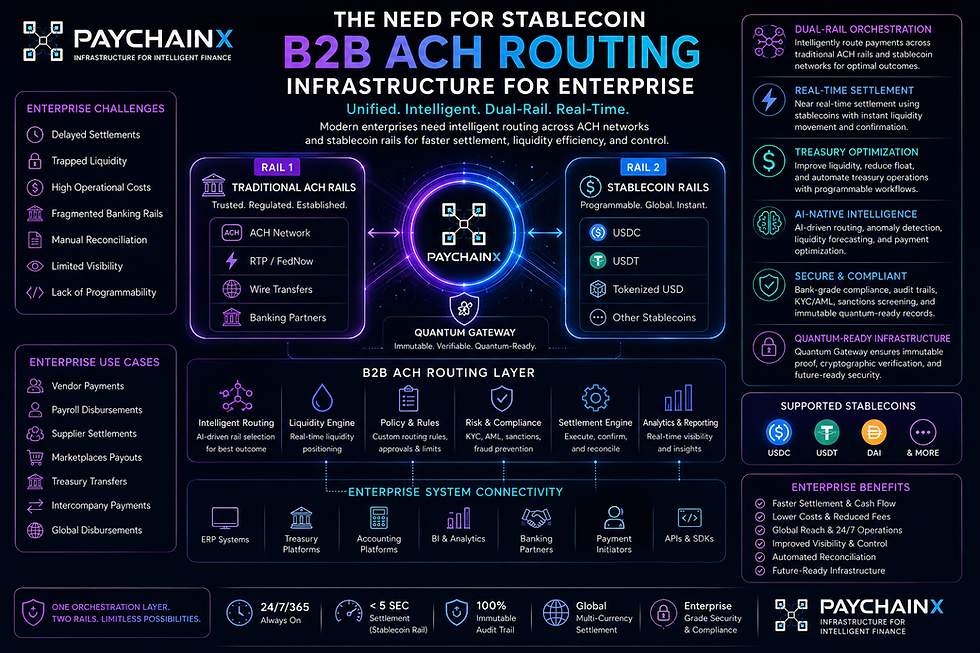
PaychainX is a dual-rail payment orchestration and execution infrastructure platform designed to unify:
traditional banking rails
card acquiring
ACH
RTP
stablecoin settlement
digital asset liquidity
merchant processing
treasury routing
quantum-safe audit infrastructure
programmable execution governance
into one governed transaction layer.
PaychainX is not simply a payment gateway.
It is a programmable financial execution control plane.
The platform acts as an orchestration layer between:
merchants
processors
acquirers
sponsor banks
treasury systems
digital asset providers
stablecoin settlement networks
AI-driven transaction infrastructure
while introducing a new category:
Quantum-Wrapped Dual-Rail Infrastructure
The Problem with Legacy Financial Infrastructure
Traditional payment systems suffer from several structural limitations.
1. Fragmented Rails
Businesses often operate across:
card processors
ACH providers
treasury platforms
banking APIs
crypto providers
settlement vendors
Every integration introduces:
latency
operational overhead
security complexity
reconciliation problems
vendor lock-in
Most companies are forced to stitch together infrastructure manually.
2. Settlement Delays
Traditional systems were built around:
banking hours
batch windows
legacy messaging systems
intermediary dependencies
Settlement may take:
hours
days
multiple reconciliation cycles
Global commerce no longer operates on banking schedules.
3. Limited Routing Intelligence
Most gateways route transactions statically.
Modern infrastructure requires:
dynamic rail selection
liquidity-aware routing
processor optimization
stablecoin settlement fallback
fee-aware orchestration
treasury-aware execution
Traditional systems are not designed for programmable execution.
4. Weak Audit Architecture
Many systems rely on:
centralized logs
mutable databases
weak evidence chains
post-event reconciliation
This creates:
operational uncertainty
compliance risk
dispute complexity
forensic limitations
Financial infrastructure now requires cryptographic auditability.
5. Quantum Threat Exposure
The future threat landscape is not hypothetical.
Financial systems are approaching a period where:
cryptographic migration
post-quantum resilience
infrastructure hardening
cryptographic agility
will become mandatory.
Most payment infrastructure today has no migration strategy.
The Emergence of Dual-Rail Infrastructure
The next era of finance is not:
crypto replacing banks
or banks replacing crypto
The future is convergence.
This creates the need for dual-rail infrastructure.
What Is Dual-Rail Technology?
Dual-rail infrastructure allows a transaction ecosystem to operate across both:
Traditional Financial Rails
AND
Digital Asset / Stablecoin Rails
simultaneously.
This means a platform can:
accept fiat
settle via stablecoin
route through ACH
utilize RTP
coordinate treasury liquidity
bridge digital and traditional systems
abstract complexity from merchants
without forcing businesses to choose one ecosystem.
This is one of the core architectural principles behind PaychainX.
The Two Rails
Rail 1 — Traditional Financial Infrastructure
This includes:
Visa
Mastercard
ACH
RTP
FedNow
wires
acquiring banks
processors
sponsor banks
These systems provide:
merchant familiarity
regulatory maturity
massive installed infrastructure
consumer ubiquity
But they are often:
slow
fragmented
expensive
inflexible
Rail 2 — Stablecoin and Digital Settlement Infrastructure
This includes:
USDC
tokenized treasury systems
programmable settlement
blockchain-based liquidity
API-native finance
digital asset treasury infrastructure
Stablecoins introduce:
near real-time settlement
programmable money movement
global liquidity access
reduced intermediary layers
treasury flexibility
But they also introduce:
compliance complexity
orchestration challenges
fragmented provider ecosystems
The future requires both rails working together.
Why Stablecoins Matter
Stablecoins are not merely “crypto.”
They represent:
programmable dollar infrastructure
API-native settlement
digital treasury mobility
real-time liquidity systems
Stablecoins allow businesses to:
move capital globally
reduce settlement friction
automate treasury operations
create programmable payment flows
without waiting for traditional banking modernization cycles.
B2B Stablecoin Infrastructure
Business-to-business infrastructure is one of the most powerful applications of stablecoin rails.
Key Advantages
1. Faster Settlement
Traditional B2B settlement may require:
ACH windows
wires
intermediary reconciliation
banking cutoffs
Stablecoins enable:
near real-time treasury movement
programmable settlement logic
global liquidity coordination
2. Treasury Optimization
Companies can:
automate liquidity movement
route capital dynamically
reduce idle treasury balances
coordinate multi-region settlement
3. Global Vendor Infrastructure
Cross-border payments become dramatically simpler.
Instead of:
correspondent banking chains
FX delays
reconciliation lag
companies can settle digitally with:
programmable controls
API-level governance
real-time evidence trails
4. Embedded Finance Expansion
Platforms can:
build programmable financial ecosystems
embed treasury operations
automate vendor payouts
integrate digital settlement into applications
without becoming full banks themselves.
B2C Stablecoin Infrastructure
Consumer-facing infrastructure is also evolving rapidly.
Emerging Consumer Models
Wallet-Native Commerce
Consumers increasingly expect:
instant movement of funds
programmable rewards
interoperable wallets
digital identity integration
Mobile Settlement Systems
Future commerce increasingly becomes:
mobile-first
API-driven
identity-linked
wallet-connected
Real-Time Consumer Payments
Consumers no longer tolerate:
multi-day holds
delayed refunds
settlement uncertainty
Dual-rail systems allow:
traditional acceptance
digital settlement flexibility
real-time execution options
The PaychainX Architecture
PaychainX was designed around several core principles.
1. Orchestration First
PaychainX acts as an orchestration layer.
Instead of replacing all infrastructure, it coordinates it.
The system abstracts:
processors
acquirers
settlement providers
stablecoin infrastructure
treasury systems
behind a unified execution layer.
2. API-Native Design
The platform is fully API-first.
Every component is designed for:
machine execution
AI integration
embedded finance
programmable workflows
automated governance
This allows PaychainX to integrate into:
SaaS platforms
marketplaces
enterprise treasury systems
fintech stacks
banking ecosystems
3. Dynamic Routing
Transactions can route dynamically based on:
rail availability
merchant configuration
liquidity
fees
settlement preferences
processor status
compliance logic
This transforms the gateway from:“simple transaction forwarding”into“financial execution intelligence.”
4. Quantum-Wrapped Audit Infrastructure
One of the most unique aspects of PaychainX is its quantum-ready audit architecture.
The system introduces:
cryptographic transaction evidence
immutable proof generation
chained audit verification
post-quantum migration readiness
governance-based execution tracking
This is not blockchain hype.
This is operational financial evidence infrastructure.
The Quantum Gateway Concept
The PaychainX Quantum Gateway introduces a new philosophy:
Transactions should not merely process.
Transactions should produce verifiable cryptographic evidence.
This changes how:
compliance
disputes
auditability
treasury validation
operational integrity
are handled.
Traditional Gateway Model
Most gateways:
process transaction
store database record
generate logs
That model was sufficient for older systems.
It is insufficient for:
AI-driven infrastructure
autonomous financial systems
regulated machine transactions
programmable finance ecosystems
Quantum Gateway Model
The PaychainX model introduces:
transaction fingerprinting
cryptographic evidence chaining
post-quantum audit architecture
execution validation
deterministic proof systems
This creates a new infrastructure category:
Governed Financial Execution
Why This Matters for AI Systems
AI systems are increasingly:
initiating transactions
routing treasury decisions
automating settlement logic
controlling operational infrastructure
Traditional payment systems were not designed for AI participation.
The future requires:
verifiable execution
deterministic authorization
programmable governance
machine-auditable infrastructure
PaychainX is being architected for that future.
Real-Time Financial Infrastructure
The financial system is moving toward:
continuous settlement
continuous liquidity
continuous orchestration
not batch-based banking.
This creates infrastructure requirements for:
low-latency routing
real-time treasury systems
instant reconciliation
programmable compliance
AI-native execution
The Role of Payment Orchestration
Payment orchestration is rapidly becoming one of the most important layers in fintech.
Why?
Because businesses no longer want:
one processor
one rail
one provider
one settlement model
They want optionality.
They want:
redundancy
routing intelligence
stablecoin access
treasury coordination
programmable payments
The orchestration layer becomes the control plane of commerce.
The Future of Embedded Finance
Embedded finance is evolving beyond:
payment widgets
checkout integrations
card issuing APIs
The next generation includes:
embedded treasury
programmable settlement
dual-rail execution
AI-driven financial workflows
machine-to-machine payments
This requires a different infrastructure stack.
The Banking Opportunity
Banks are beginning to recognize a major shift.
The future banking stack will require:
stablecoin interoperability
programmable treasury systems
API orchestration
digital settlement layers
quantum-safe audit controls
Financial institutions that fail to modernize may lose infrastructure relevance.
Why Quantum-Ready Infrastructure Matters
Quantum computing discussions are often misunderstood.
The issue is not:“quantum computers tomorrow.”
The issue is:long-term infrastructure survivability.
Financial systems must begin preparing for:
cryptographic migration
future-proof audit systems
crypto agility
layered security architectures
PaychainX approaches this through:
modular cryptographic architecture
quantum-ready evidence layers
upgradeable verification models
governance-first infrastructure design
Stablecoins and Regulation
The regulatory environment around stablecoins is rapidly evolving.
Governments increasingly recognize:
stablecoins are infrastructure
digital dollars are inevitable
programmable finance is expanding
tokenized settlement systems will grow
The question is no longer:“Will stablecoins exist?”
The question is:“How will they integrate into regulated commerce?”
Dual-rail systems provide the bridge.
Why Merchants Need Dual-Rail Infrastructure
Merchants increasingly demand:
lower costs
faster settlement
treasury flexibility
global reach
reduced dependency on single providers
Dual-rail architecture enables:
optionality
redundancy
programmable routing
digital settlement access
without forcing merchants to abandon traditional commerce systems.
The Evolution of Financial APIs
Financial APIs are evolving from:“simple transaction endpoints”into“programmable execution infrastructure.”
Future APIs will increasingly include:
governance layers
authorization logic
routing intelligence
treasury controls
compliance automation
cryptographic evidence systems
This is the direction PaychainX is building toward.
The Rise of Machine Commerce
Future commerce will increasingly involve:
AI agents
autonomous systems
machine-to-machine settlement
programmable economic workflows
Infrastructure must evolve accordingly.
The gateway of the future is not merely:a payment switch.
It becomes:a governed execution environment for financial activity.
Why Infrastructure Matters More Than Apps
Applications change rapidly.
Infrastructure persists.
The companies that define:
protocols
orchestration layers
execution systems
settlement architecture
often become the long-term winners of technology transitions.
PaychainX is being architected as infrastructure-first.
The Strategic Vision
The long-term vision behind PaychainX is to create:
A unified financial execution layer
for:
traditional commerce
digital settlement
AI-driven finance
programmable treasury systems
real-time global payments
while introducing:
governed execution
cryptographic auditability
quantum-ready infrastructure
dual-rail orchestration
into modern commerce.
The New Financial Stack
The next-generation financial stack likely includes:
Identity Layer
Who is authorized?
Governance Layer
What is allowed?
Execution Layer
How does it route?
Settlement Layer
Which rail settles?
Audit Layer
What proof exists?
Treasury Layer
How is liquidity coordinated?
AI Layer
How do autonomous systems interact safely?
PaychainX is designed to operate across these layers.
Conclusion
The financial world is entering a transition period comparable to:
the rise of cloud computing
the emergence of APIs
the birth of mobile infrastructure
the adoption of real-time systems
The separation between:
traditional finance
and
programmable digital finance
is collapsing.
The future is not one rail replacing another.
The future is orchestration.
Dual-rail infrastructure represents the convergence of:
banking systems
stablecoin settlement
programmable finance
AI-native infrastructure
cryptographic governance
real-time treasury systems
This transition creates the need for:
governed execution
quantum-ready architecture
programmable routing
cryptographic audit systems
interoperable financial infrastructure
PaychainX is being built for that future.
Not as a simple payment gateway.
But as a programmable financial execution infrastructure layer for the next era of commerce.


Comments