
PaychainX and the Emergence of the Financial Orchestration Layer

Why the Next Leaders in Finance Will Control Routing Execution and Settlement Infrastructure

The financial industry is entering a structural transformation.
For decades, payments operated through fragmented systems:
processors
card networks
ACH providers
acquiring banks
treasury platforms
settlement vendors
wire systems
regional banking infrastructure
Each layer evolved independently.
Every provider created:
isolated APIs
disconnected routing systems
proprietary settlement models
siloed treasury infrastructure
fragmented compliance workflows
The result was operational complexity hidden beneath modern commerce.
Businesses today often operate across:
multiple processors
several acquiring banks
ACH providers
stablecoin systems
treasury vendors
embedded finance APIs
international settlement layers
But the underlying infrastructure was never designed to function as one unified execution environment.
This is why a new category is emerging:
The Financial Orchestration Layer
And this is where PaychainX is positioning itself.
The Rise of Financial Orchestration
Traditional payment gateways were built for transaction forwarding.
Modern infrastructure requires much more.
Today’s financial systems must coordinate:
multiple payment rails
treasury systems
liquidity movement
settlement timing
compliance logic
routing intelligence
AI-driven workflows
stablecoin interoperability
This creates the need for orchestration infrastructure.
Instead of relying on one:
processor
rail
bank
settlement model
the orchestration layer intelligently coordinates them all.
What Is a Financial Orchestration Layer?
The orchestration layer acts as the intelligence system of modern finance.
It determines:
where transactions route
how liquidity moves
which settlement rail executes
how treasury systems coordinate
how compliance policies apply
how evidence is generated
how execution is verified
This transforms payments from:“simple processing”into:“programmable financial execution.”
Why This Matters
The future financial stack is becoming increasingly complex.
Businesses now require:
real-time settlement
stablecoin interoperability
treasury automation
embedded finance
API-native banking
programmable liquidity
AI-driven financial systems
Traditional infrastructure was not designed for this environment.
The orchestration layer becomes the bridge between:
legacy financial systems
AND
programmable digital finance
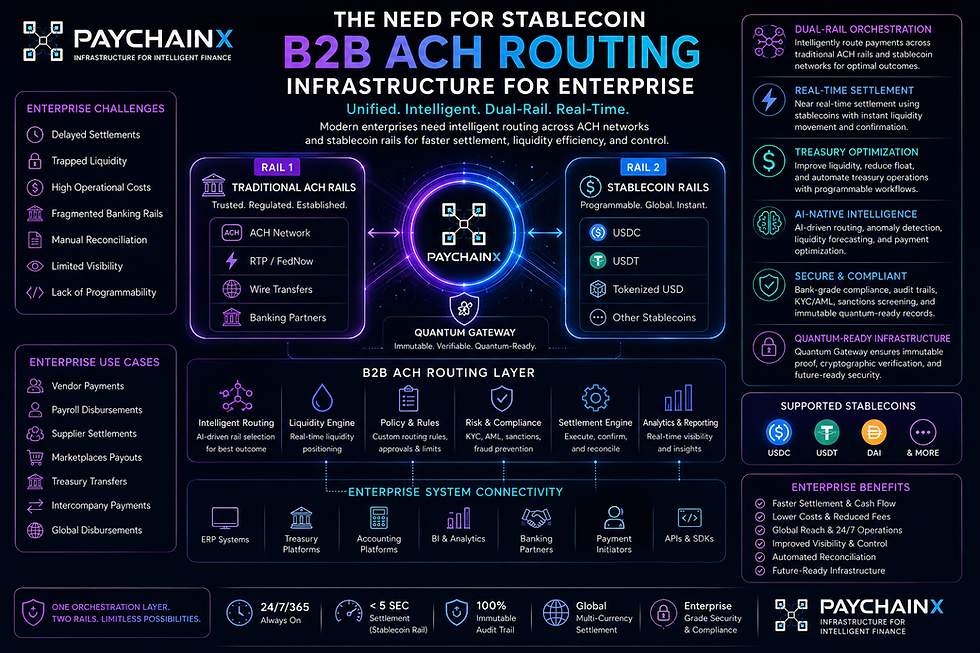
The Emergence of Dual-Rail Infrastructure
One of the most important infrastructure shifts happening globally is the rise of:
dual-rail financial systems
This means operating across:
traditional financial rails
AND
digital settlement rails
simultaneously.
PaychainX was architected around this model from the beginning.
Rail 1 — Traditional Financial Infrastructure
Traditional rails include:
Visa
Mastercard
ACH
RTP
FedNow
acquiring banks
sponsor banks
processor ecosystems
These systems remain critical because they provide:
merchant adoption
consumer familiarity
regulatory structure
global transaction reach
But they also suffer from:
settlement delays
fragmented APIs
treasury inefficiency
limited programmability
operational rigidity
Rail 2 — Stablecoin and Digital Settlement Infrastructure
Digital settlement rails introduce:
programmable liquidity
API-native settlement
near real-time treasury movement
tokenized value systems
global interoperability
Stablecoins are rapidly becoming infrastructure.
They enable:
faster settlement
treasury flexibility
programmable finance
reduced intermediary friction
continuous global commerce
The future financial system requires both rails operating together.
Why Orchestration Is More Valuable Than Processing
Processing is becoming commoditized.
Orchestration is not.
The long-term infrastructure value shifts toward:
routing intelligence
treasury coordination
settlement optimization
liquidity management
execution governance
interoperability
compliance automation
The orchestration layer becomes the strategic control point of finance.
PaychainX and Financial Execution Infrastructure
PaychainX is not being built as a simple payment gateway.
It is being designed as:
programmable financial execution infrastructure
The platform coordinates:
payment routing
stablecoin settlement
treasury systems
processor orchestration
banking integrations
real-time execution logic
AI-native payment flows
through one unified orchestration layer.
Why Real-Time Infrastructure Changes Everything
Commerce no longer operates in banking windows.
Modern businesses expect:
instant settlement
continuous liquidity movement
automated treasury coordination
programmable financial workflows
Real-time infrastructure changes:
cash flow
treasury operations
risk management
customer experience
settlement efficiency
This creates enormous demand for orchestration platforms capable of coordinating multiple financial rails dynamically.
AI and the Future of Financial Infrastructure
Artificial intelligence is accelerating the transition toward programmable finance.
AI systems increasingly:
initiate transactions
optimize routing
coordinate treasury logic
automate settlement workflows
manage liquidity movement
Legacy financial systems were not designed for autonomous infrastructure participation.
This creates the need for:
deterministic execution
programmable governance
auditability
verification systems
execution intelligence
The orchestration layer becomes critical infrastructure for AI-native commerce.
The Quantum Gateway Model
PaychainX also introduces a quantum-ready infrastructure philosophy.
Traditional payment systems rely heavily on:
mutable logs
centralized databases
fragmented audit systems
The PaychainX Quantum Gateway introduces:
cryptographic transaction evidence
deterministic execution verification
immutable proof chains
quantum-ready audit architecture
governed financial execution
This creates a new category:
quantum-wrapped financial infrastructure
Why Enterprises Need Orchestration
Large enterprises increasingly require:
processor redundancy
rail flexibility
treasury coordination
programmable settlement
stablecoin access
API-native infrastructure
They no longer want:
fragmented systems
disconnected vendors
siloed treasury operations
The orchestration layer becomes the operational bridge across all financial infrastructure.
The Treasury Transformation
Treasury systems are evolving rapidly.
Historically treasury infrastructure operated:
manually
regionally
slowly
in isolated banking environments
The next generation requires:
real-time liquidity awareness
programmable treasury systems
stablecoin interoperability
automated settlement coordination
This transition dramatically increases the importance of orchestration infrastructure.
Why Stablecoins Matter
Stablecoins are no longer merely digital assets.
They are becoming:
programmable dollar infrastructure
API-native settlement systems
treasury mobility layers
real-time liquidity networks
The future financial stack will likely include stablecoins operating alongside traditional banking infrastructure.
The orchestration layer is what connects both systems together.
The Infrastructure Opportunity
Historically, the companies that controlled infrastructure layers became some of the most valuable companies in technology.
Examples include:
cloud infrastructure providers
operating systems
networking protocols
database ecosystems
API platforms
In finance, orchestration infrastructure may become one of the defining control layers of the next decade.
Leadership in the Orchestration Layer
The companies that successfully manage:
routing
execution
settlement
treasury coordination
interoperability
programmable finance
may ultimately control the operational layer of modern commerce.
This is why orchestration leadership matters.
The value is no longer just in moving transactions.
The value is in coordinating the entire execution environment around them.
The Future Financial Stack
The next-generation financial stack will likely include:
dual-rail execution
AI-native finance
programmable treasury systems
stablecoin settlement
API-based banking
real-time liquidity systems
quantum-ready audit infrastructure
The orchestration layer becomes the connective tissue across all of them.
Conclusion
The financial system is entering a new infrastructure era.
The future of commerce will require:
intelligent routing
programmable settlement
dual-rail interoperability
treasury coordination
AI-native execution systems
quantum-ready audit infrastructure
The companies that lead orchestration infrastructure may ultimately define the next generation of global financial systems.
PaychainX is building toward that future.
Not simply as a payment gateway.
But as a leadership platform for


Comments